Stress does not exist only in your thoughts. You can often feel it physically before you even realize how stressed you are. Your shoulders tighten, breathing becomes shallow, your heart beats faster, and your stomach suddenly feels uncomfortable.
These reactions are part of the body’s built-in stress system. They are useful when you need to respond quickly to a challenge, but they can become exhausting when pressure continues for hours, days, or weeks.
This is where relaxation techniques can help.
Understanding how relaxation skills can calm the body’s stress response gives you practical ways to move from a state of high alert toward recovery.
Techniques such as slow breathing, progressive muscle relaxation, mindfulness, and guided imagery may help reduce physical tension and encourage calmer physiological activity.
The National Center for Complementary and Integrative Health describes relaxation techniques as practices designed to produce the body’s natural “relaxation response,” characterized by slower breathing, lower blood pressure, and reduced heart rate.
You cannot remove every stressful situation, but you can teach your body how to recover afterward.
What Happens to Your Body When You Feel Stressed?
The stress response is essentially a preparation system.
When your brain detects a potential threat or important challenge, the sympathetic nervous system becomes more active. Heart rate may increase, breathing becomes quicker, muscles tighten, and the body redirects resources toward dealing with the immediate situation.
This can be very useful.
If you suddenly need to avoid an approaching vehicle, you want your body to react immediately. You do not want to spend several minutes calmly evaluating the situation.
The difficulty comes when everyday life repeatedly activates the same system.
A tense meeting, financial worries, family conflict, endless notifications, and a deadline may not be physical emergencies, but your body can still respond with increased arousal.
Over time, you may notice tense muscles, irritability, trouble relaxing, difficulty sleeping, or a feeling that you are constantly “switched on.”
Relaxation skills are designed to interrupt some of that activation.
What Is the Relaxation Response?
The relaxation response is broadly the opposite of remaining in a highly activated stress state.
According to NCCIH, relaxation methods generally combine focused attention with strategies such as breathing exercises, guided imagery, or progressive relaxation. These practices are intended to produce physiological changes associated with reduced arousal.
You can think of it as giving the body a signal:
“There is no immediate emergency. You can reduce your level of alertness.”
This does not mean your problems disappear.
If you have a deadline tomorrow, relaxation will not complete the work for you. But calming your physiological responce may make it easier to think clearly and decide what to do next.
That distinction matters.
Relaxation is not avoidance. Ideally, it gives you a more stable physical and emotional state from which you can face the problem.
Slow Breathing Can Change Physical Arousal
Breathing is one of the simplest ways to influence the stress response because it is both automatic and partly under voluntary control.
When people feel stressed or anxious, breathing may become faster, shallower, or concentrated in the upper chest.
Slowing the breath changes that pattern.
Research reviews suggest that slow breathing can influence cardiovascular and autonomic nervous system activity, including measures related to heart rate variability and parasympathetic activity.
A 2023 review of breathing practices also found evidence that structured breathing techniques can reduce stress and anxiety, although the exact methods and study designs vary considerably.
A Simple Slow-Breathing Practice
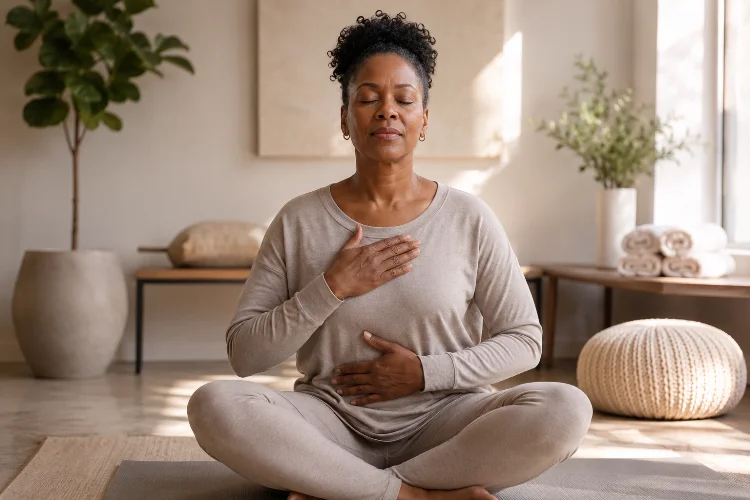
Sit comfortably and allow your shoulders to relax.
Breathe in slowly through your nose, then allow the exhale to be gentle and slightly longer. Avoid forcing enormous breaths; comfortable, controlled brething is the goal.
Continue for a few minutes while paying attention to the sensation of breathing.
The APA provides similar stress-management exercises involving slow inhalation and longer exhalation.
For many people, the value comes from repetition rather than doing one dramatic breathing session during a crisis.
Progressive Muscle Relaxation Releases Hidden Tension
Stress can make muscles tense without us consciously noticing.
You might spend an entire afternoon with your jaw clenched or your shoulders raised toward your ears.
Progressive muscle relaxation, often shortened to PMR, helps people notice the difference between tension and relaxation.
The technique generally involves deliberately tightening one muscle group for a short period and then releasing it before moving to another area of the body. NCCIH lists progressive relaxation among established relaxation techniques.
For example, you might gently tense your hands, notice the feeling, and then let them relax. You could then move to your shoulders, face, abdomen, or legs.
A 2024 systematic review covering 46 studies and more than 3,400 adults found that PMR interventions were associated with reductions in stress, anxiety, and depressive symptoms, although interventions and populations differed across studies.
The benefit is partly practical: you become better at noticing physical tension before it has been there for hours.
Mindfulness Helps You Stop Fighting Every Thought
Sometimes stress continues because the body is responding not to what is happening now, but to what the mind predicts might happen next.
“What if I fail?”
“What if they are angry?”
“What if tomorrow goes badly?”
Mindfulness practices train attention toward present-moment experiences without immediately judging or reacting to them.
NCCIH notes that meditation and mindfulness have been studied for conditions including stress, anxiety, depression, and sleep problems, though research quality and effectiveness vary between techniques and populations.
A mindfulness exercise can be surprisingly simple.
For two minutes, notice your breathing, the sensation of your feet touching the floor, and sounds around you. When your mind wanders into worrying, notice it and return attention to the present.
You are not trying to force every thought away.
The goal is learning that a worrying thought can appear without automatically becoming the centre of your attention.
That small mental shift can create valuable releif when your mind has been racing all day.
Guided Imagery Can Give Attention Somewhere Calmer to Go
Relaxation does not always require focusing directly on the body.
Guided imagery uses imagination and sensory details to create a mental scene associated with safety, comfort, or calm. NCCIH includes guided imagery among commonly used relaxation approaches.
Imagine sitting somewhere peaceful.
Instead of simply thinking “beach,” notice details. What does the air feel like? What sounds can you hear? Is the sun warm? What does the horizon look like?
The more specific the mental image becomes, the more your attention moves away from repetitive stress-related thinking.
Guided imagery is not about pretending real problems do not exist.
It is a temporary shift in attention that can give your nervous system a chance to settle before returning to those problems.
Research comparing guided imagery and progressive muscle relaxation has found improvements in physical and emotional symptoms in some groups, though outcomes depend on the population and study design.
Why Practicing Relaxation Before You Are Overwhelmed Matters
Many people try relaxation techniques only when their stress is already at maximum intensity.
That is like learning how to swim after falling into deep water.
Skills tend to become easier to use when you practise them during relatively calm moments.
You might spend five minutes breathing slowly after lunch, use progressive muscle relaxation before bed, or practise mindfulness during a quiet morning.
Over time, the routine becomes familiar.
Then, when you notice your body becoming tense before a difficult conversation or presentation, you already know what to do.
Relaxation skills are not necessarily about reaching a perfectly peaceful state. Even shifting from extremely tense to moderately tense can be useful.
Consistency matters more than perfection.
A simple technique performed regualrly is often more practical than an elaborate routine you rarely use.
Relaxation Is Helpful, but It Cannot Solve Every Stressor
Relaxation techniques can support stress management, but they should not become a substitute for dealing with problems that require action.
If you are stressed because you have twelve unfinished tasks, calming breathing may help you think-but you still need a plan for those tasks.
If a relationship is repeatedly causing distress, progressive relaxation may reduce tension temporarily, but communication or boundaries may still be necessary.
Healthy stress management often combines two approaches:
calming the stress response and addressing the stressor.
The APA similarly recommends combining calming approaches with broader strategies such as physical activity, social connection, sleep, and dealing constructively with sources of stress.
Relaxation techniques are also generally considered safe for healthy people, but NCCIH notes that some individuals may occasionally experience increased anxiety, intrusive thoughts, or other uncomfortable reactions.
People with significant health or psychological concerns may benefit from discussing techniques with an appropriate healthcare professional.
How to Build a Simple Daily Relaxation Routine
You do not need an hour-long wellness ritual.
Start with five minutes.
Choose one technique that feels realistic. Slow breathing may work well at your desk. Progressive muscle relaxation might fit better before sleep. Mindfulness can be practised while sitting quietly, and guided imagery may help when you need a short mental break.
Try using the same technique at approximately the same time each day for a week.
Then notice what changes.
Do your shoulders feel less tense? Does your breathing settle faster? Do you recover more quickly after frustrating moments?
If one technique feels uncomfortable or ineffective, try another. Relaxation is not one-size-fits-all.
The aim is to build a small collection of strategies you can use depending on the situation.
Relaxation skills can help calm the body’s stress response by reducing physical arousal and creating conditions that support recovery.
Slow breathing may influence autonomic activity, progressive muscle relaxation can reduce muscular tension, mindfulness can redirect attention, and guided imagery can provide a temporary mental break from repetitive stress.
None of these techniques removes every difficulty from life. Their real value is helping you respond to those difficulties from a calmer starting point.
Begin with one simple practice and use it for a few minutes each day. Pay attention to how your body responds rather than expecting instant perfection.
The more familiar relaxation becomes, the easier it may be to use when pressure rises. And when stress remains persistent or overwhelming, consider combining self-care strategies with appropriate professional support.